Why General Shah Nawaz Khan Deserves to Be Remembered This Independence Day
By Afroz Alam Sahil
Every year on August 15, India’s Prime Minister addresses the nation from the ramparts of the Red Fort in Delhi. It was at this same fort, in 1945, that Major General Shah Nawaz Khan stood trial for waging war against the British Empire. A Muslim officer in Netaji Subhas Chandra Bose’s Indian National Army, he had led troops into battle against colonial forces across Southeast Asia, been captured, and was sentenced to death. His court-martial, alongside Colonel Prem Kumar Sehgal and Colonel Gurbaksh Singh Dhillon, provoked mass protests across the country and became one of the final catalysts for British withdrawal from India. The slogan that echoed through the streets of Delhi became a rallying cry of the independence movement: “Lal Qile se aayi awaaz, Sehgal, Dhillon aur Shah Nawaz.”
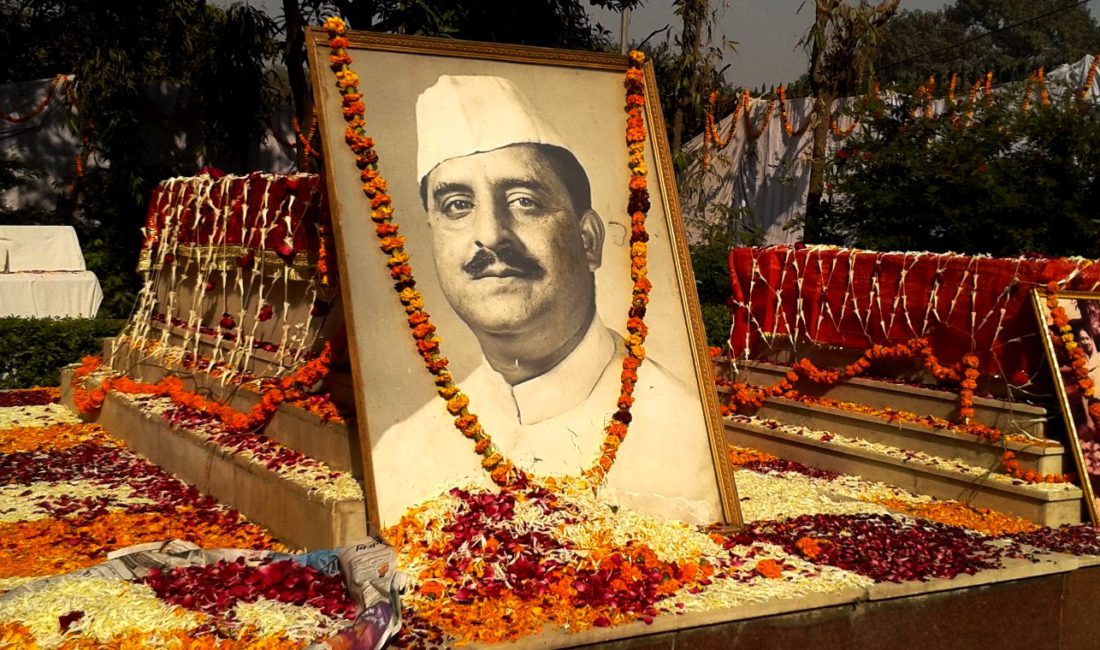
After his release, Shah Nawaz Khan chose the path of non-violence at Mahatma Gandhi’s urging, joined the Indian National Congress, and went on to serve as a Union Minister for over two decades. He represented Meerut in Parliament through four terms, held portfolios ranging from Agriculture to Petroleum, and chaired the commission that investigated the circumstances of Netaji Bose’s death. He was buried near the Red Fort with full state honours in 1983.
Beyond politics, Shah Nawaz Khan was connected to one of India’s most recognizable families. The Bollywood actor Shah Rukh Khan’s father, Mir Taj Mohammed Khan, was his cousin and migrated from Pakistan to India alongside him after Partition.
His story traces an arc from armed resistance to democratic nation-building, from a death sentence in a colonial courtroom to the highest levels of Indian government.
Early Life and Military Career
General Shah Nawaz Khan was born on 24 January 1914 in the village of Matur, in the Rawalpindi District of British India (now in Pakistan). His father, Lieutenant Sardar Tikka Khan, served for nearly three decades in the British Indian Army with the 58th Vaughan’s Rifles (Frontier Force), instilling in him an early exposure to military life.
After completing his early education, Shah Nawaz Khan went on to study at the Prince of Wales Royal Indian Military College in Dehradun, one of the premier institutions established to train future military leaders in colonial India.
From Prisoner of War to Leader of the Indian National Army
In 1940, Shah Nawaz Khan was commissioned as an officer in the British Indian Army. In December 1941, as part of the Second World War, Japanese forces launched a major offensive against Singapore, and the British deployed nearly 60,000 Indian soldiers, including Captain Shah Nawaz Khan.
The British forces were ultimately defeated, and Khan, along with thousands of other soldiers, was taken prisoner of war. During his captivity, he came into contact with Indian nationalists and revolutionaries aligned with Netaji Subhas Chandra Bose. Deeply influenced by their vision of an independent India, he joined the Azad Hind Fauj, also known as the Indian National Army (INA), and rapidly rose to positions of leadership.
Role in the Freedom Struggle
Recognized for his leadership abilities, Shah Nawaz Khan was inducted into the cabinet of the Indian National Army’s (INA) Provisional Government of Free India. Between 1942 and 1945, the Azad Hind Fauj engaged British forces across Southeast Asia and, for a period, established control over large stretches of territory during its campaign against colonial rule.
In December 1944, he was appointed commander of the INA detachment stationed in Mandalay, Burma (now Myanmar). Owing to the close trust placed in him by Netaji Subhas Chandra Bose, he was later selected to lead the Subhas Brigade—a special unit formed from elite INA soldiers.
During military operations in Burma in 1945, General Shah Nawaz Khan and several of his comrades were arrested by British forces. The INA’s senior leadership at the time included Major General Shah Nawaz Khan, Colonel Prem Kumar Sehgal, and Colonel Gurbaksh Singh Dhillon. In 1946, all three were put on trial for mutiny at the Red Fort in Delhi.
These trials ignited widespread public protests across India and became a turning point in the independence movement, significantly intensifying popular resistance to British rule. Facing overwhelming public pressure, the British government was ultimately compelled to release Shah Nawaz Khan and his associates. During this period, he remained in contact with leading figures of the national movement, including Mahatma Gandhi, and was defended in court by Jawaharlal Nehru.
Gandhi’s Colonel of Non-Violence
General Shah Nawaz Khan was regarded as one of Mahatma Gandhi’s close associates, a relationship reflected in Gandhi’s letters and public speeches, in which he frequently referred to him by name. Their association symbolized the bridge between armed resistance and the philosophy of non-violence that shaped India’s independence movement.
On the occasion of the 50th birth anniversary of Netaji Subhas Chandra Bose, Shah Nawaz Khan declared, “While living outside India, we fought for our country’s freedom with arms; now we shall serve India through non-violence.” Mahatma Gandhi echoed this sentiment while addressing members of the Indian National Army in Madras on 22 January 1946 and later reiterated it during his prayer meeting in Mumbai on 18 February 1946.
Contemporary records further document their close interaction. According to a report in the Bombay Chronicle dated 13 March 1946, Shah Nawaz Khan met Gandhi at Birla Bhavan in Delhi on 12 March, where the two held discussions for nearly ninety minutes. On 22 March 1946, Gandhi visited a military camp in Aravalli Kanchan, Maharashtra, and once again mentioned Shah Nawaz Khan while addressing the soldiers. Their engagement continued through personal meetings as well as an exchange of letters, many of which survive as historical evidence of their dialogue.
At Gandhi’s urging, following the dissolution of the Indian National Army in 1946, Shah Nawaz Khan joined the Indian National Congress. Later that year, he worked in Bihar to assist victims of communal violence, alongside Khan Abdul Ghaffar Khan. He remained in the region during this period of unrest, and was present at the funeral of Professor Abdul Bari, who was assassinated in Bihar in March 1947.
Gandhi repeatedly acknowledged and praised Shah Nawaz Khan’s relief and peace-building efforts in Bihar during 1947. He spoke at length about Khan’s work during his prayer meetings on 29 April and 1 May 1947, and earlier, on 15 April 1947, the two were together at Gandhi’s camp in Patna. During one such conversation, Gandhi expressed his faith in him, saying: “I have great hopes for you. I wish to make you a complete soldier of non-violent weapons. You became a colonel under Netaji; in the same way, I want to make you a colonel of non-violence.”
Political Life After Independence
Even after India achieved independence in 1947, Shah Nawaz Khan continued to work in Masurhi, Bihar, focusing on relief and rehabilitation efforts. In a letter dated 7 October 1947, Mahatma Gandhi wrote to him: “Dear General Shah Nawaz, If the work you are doing there does not go to the dogs in your absence, you may leave it to go to the Punjab-Pakistan.” Despite this, Shah Nawaz Khan chose not to return to his ancestral home in what had become Pakistan; instead, his family migrated to India.
Shah Nawaz Khan entered electoral politics in independent India and was elected to the first Lok Sabha (India’s lower house of Parliament) in 1952 from Meerut, representing the Indian National Congress. He went on to win the same constituency in 1957, 1962, and 1971. Over the course of his political career, he served as a Union Minister for a total of 23 years.
Beginning in 1952, he served as Parliamentary Secretary and later as Deputy Minister for Railways. From 1957 to 1964, he held the portfolio of Food and Agriculture. He was again appointed Minister of Agriculture in 1965, followed by his tenure as Minister of Labour, Employment, and Rehabilitation in 1966. Between 1971 and 1975, he served as Minister for Petroleum and Chemicals, as well as Agriculture and Irrigation. From 1975 to 1977, he additionally served as Chairman of the Food Corporation of India while continuing as Union Minister for Agriculture and Irrigation.
In 1956, the Government of India constituted a commission to examine the circumstances surrounding the death of Netaji Subhas Chandra Bose. Shah Nawaz Khan was appointed chairman of this commission, underscoring the trust placed in him by the national leadership. He also authored a memoir on the Indian National Army and Netaji Subhas Chandra Bose, regarded as an important firsthand account of the INA movement.
Representing the Meerut constituency for decades, Shah Nawaz Khan played a stabilizing role in public life, and the city remained free of major communal disturbances during his tenure. From 1977 to 1983, he served as the national in-charge of the Congress Seva Dal, the party’s volunteer organization. He remained associated with the Indian National Congress until the end of his life, continuing his commitment to public service and national unity.
General Shah Nawaz Khan passed away on 9 December 1983 while still serving the Indian National Congress. His life—spanning armed resistance, political leadership, and a steadfast commitment to unity and nation-building—remains a powerful testament to the ideals of freedom, sacrifice, and service. He is remembered not only as a soldier and statesman, but as a figure whose legacy continues to inspire generations in independent India and beyond.